
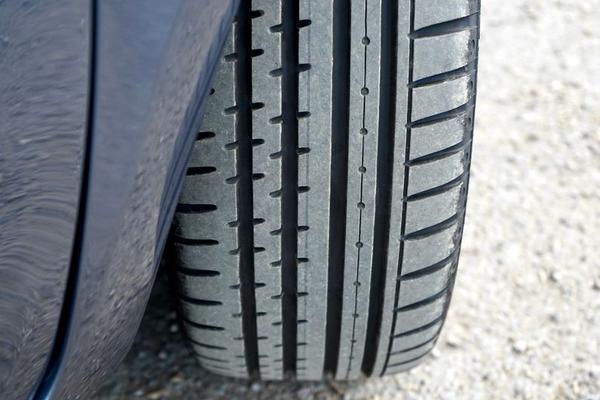
A tyre can look usable from a few steps away and still be illegal to drive on. In the UK, tread depth is not judged by appearance alone. It is measured in specific grooves, across a defined part of the tyre, all the way around.
For most cars, the legal tyre tread depth in the UK is 1.6 mm. That is a minimum, not a target for when to start considering replacement. Here is how the rule works and what to check before worn tyres become a safety or legal problem.
What is the legal minimum tyre tread depth in the UK?
Under UK tyre law, cars, light vans and light trailers must have at least 1.6 mm of tread in the primary grooves across the central three-quarters of the tread width, continuously around the entire circumference. The rule applies to each tyre individually, not to the average depth across four tyres.
A tyre measuring 2.4 mm in one area but 1.4 mm elsewhere in the required band does not comply. Nor does one with plenty of tread near a shoulder but less than 1.6 mm in a central primary groove.
The requirement comes from road vehicle regulations and appears in the Highway Code and DVSA MOT guidance. It is a legal standard, not a figure selected by individual garages.
What does the central three-quarters rule mean?
Imagine dividing the width of the tread that normally touches the road into four equal strips. On a car tyre, the central three strips form the area where the primary grooves must meet the 1.6 mm minimum.
The outer edges are treated differently for this particular measurement, but damaged or badly worn shoulders are not automatically safe. Tyres must remain fit for use and free from dangerous defects. Uneven edge wear deserves investigation even when the main grooves pass.
How to measure tyre tread depth accurately
Use a tread depth gauge
A tread depth gauge provides a direct reading. Park safely on level ground, turn off the engine and secure the vehicle. Insert its probe into a primary groove, with the gauge base flat against the adjacent tread blocks. Read the measurement without pushing into the rubber.
Measure several primary grooves across the central three-quarters, then check different positions around the tyre. Turn the steering wheel to improve access to front tyres if safe. If parts remain inaccessible, ask a tyre professional rather than reaching under an unsecured vehicle.
Understand the 20p coin test
The familiar 20p coin test offers a visual warning, not an exact measurement of the statutory limit. Put the coin in a main groove; if its outer border is clearly visible, check the depth with a gauge. A hidden border does not prove every section complies.
Look for tread-wear indicators
Many tyres have raised wear bars inside the main grooves. When surrounding tread reaches these bars, it is around the legal wear limit. A gauge is more useful for tracking the remaining depth before that point.
A practical example: one tyre, different readings
Suppose a front tyre measures 2.7 mm in two central grooves but just 1.5 mm in another primary groove within the required band. It fails the legal requirement despite the healthier readings elsewhere. Replacement is necessary, along with a check for incorrect inflation, misalignment or suspension problems.
This is why one measurement at the easiest point can give false reassurance. Check several grooves and several positions around each tyre.
Should you replace tyres before 1.6 mm?
You do not have to wait for 1.6 mm. As grooves become shallower, tyres generally have less capacity to disperse standing water, increasing the potential for aquaplaning. Wet grip also depends on tyre design, speed, road surface and conditions, so no tread measurement alone guarantees safety.
When tyres approach the minimum, arrange an assessment and plan replacement before they become illegal. Check more frequently if you drive long distances or encounter heavy rain. Routine tyre pressure checks can also help prevent abnormal wear.
Other faults the tread test will not reveal
Depth is only one part of tyre roadworthiness. Inspect accessible tread and sidewalls for bulges, cuts, exposed cords, embedded objects and unusual wear. A bulge may indicate internal damage and calls for urgent professional attention, even if the grooves remain deep.
Repeated low pressure, vibration or pulling to one side also warrants investigation. Learning about uneven tyre wear patterns can help you describe the symptoms, but a technician should check suspected safety defects.
Do motorcycles and larger vehicles follow the same rules?
No. Most motorcycles require at least 1 mm in a continuous band spanning three-quarters of the tread width around the circumference, with the tread pattern visible over the full width. Mopeds have a visible-tread requirement. Larger goods and qualifying passenger vehicles generally have a 1 mm minimum.
Cars, light vans and light trailers use 1.6 mm. Certain unusual vehicle categories have specific rules, so consult the relevant DVSA guidance rather than assuming the car standard applies everywhere.
What happens if a tyre is below the legal limit?
A tyre below its minimum can cause an MOT failure and make a vehicle unroadworthy. DVSA guidance classifies insufficient tread on cars as a dangerous MOT defect.
According to government roadworthiness guidance, driving a vehicle in a dangerous condition may result in a fine of up to £2,500, three penalty points and a possible driving ban. The outcome depends on the offence and circumstances. A valid MOT certificate does not excuse a tyre that wears below the limit afterwards.
Measure tread regularly and before longer journeys. Check visible condition and inflation at the same time. A tyre maintenance checklist can make these inspections easier to remember.
Frequently asked questions
Is 2 mm tyre tread legal in the UK?
For a normal car tyre, yes, provided every required primary groove has at least that depth around the full circumference and the tyre is otherwise roadworthy. However, 2 mm leaves little margin above the 1.6 mm threshold.
Does 1.6 mm apply to every groove?
It applies to the primary grooves within the central three-quarters of a car tyre’s tread width, around the whole circumference. Shallow secondary grooves and decorative cuts are not assessed in the same way.
Can a car pass its MOT with exactly 1.6 mm?
Yes, if it meets the minimum throughout the required area and has no other disqualifying defects. But it may become illegal after further wear. An MOT is a snapshot, not a guarantee for the following year.
Do winter and all-season tyres have different legal limits?
Not for ordinary cars on UK roads. Summer, winter and all-season tyres share the same 1.6 mm statutory minimum, although their designs and performance characteristics differ.
Keep a margin, not just a legal measurement
The minimum tyre tread UK drivers should remember is 1.6 mm across the central three-quarters of each car tyre, around its entire circumference. Use a gauge, watch for uneven wear and have damage investigated promptly. A short inspection is easier than discovering a worn tyre on a motorway journey or during an MOT.