
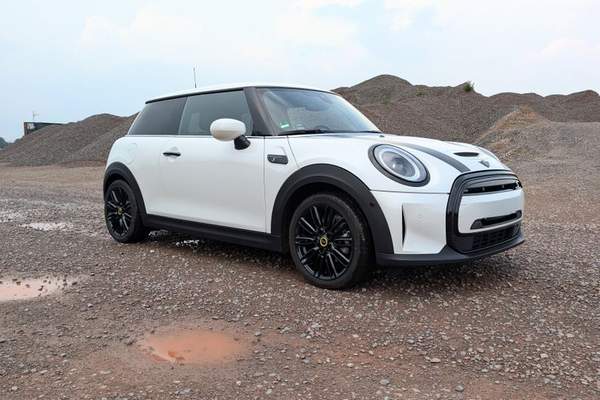
The Renault 5 E-Tech electric and MINI Cooper Electric are two of the most characterful small electric cars in the UK. Both use familiar design heritage, suit city streets and offer enough range for more than short urban trips. Yet they take different approaches. The Renault 5 is a five-door, five-seat hatchback built around practicality and value, while the MINI is a three-door, four-seat model focused more on performance and premium design.
For UK buyers comparing the Renault 5 vs MINI Cooper Electric, the deciding factors are likely to be range, rear-seat access, charging needs and price rather than styling alone.
Range and battery choices
The Renault 5 is offered with a 40 kWh battery and 120 hp motor or a 52 kWh battery with 150 hp. Renault currently quotes up to 194 miles WLTP for the smaller battery and up to 259 miles for the larger one. Real-world mileage will vary with weather, speed, heating use and driving style.
The MINI Cooper Electric comes in E and SE forms. Current UK figures run from roughly 179 miles for the Cooper E to around 250 miles for the longest-range versions. The maximum Renault 5 range is therefore slightly higher, but both larger-battery models should cover typical commuting and weekend use comfortably for many drivers.
If you mostly drive 20 to 40 miles a day and charge at home, either entry-level battery may be enough. Regular motorway users will appreciate the extra buffer of the larger battery.
Charging speed and convenience
The 40 kWh Renault 5 supports up to 80 kW DC rapid charging, while the 52 kWh version reaches up to 100 kW. Renault quotes about 30 minutes for a 15% to 80% rapid charge under suitable conditions. AC charging is supported at up to 11 kW.
The MINI Cooper E can rapid-charge at up to 75 kW, while the SE reaches up to 95 kW. MINI quotes roughly 28 to 30 minutes for a 10% to 80% DC charge. Both cars are therefore closely matched for typical public rapid-charging stops.
For drivers with a home wallbox, those peak figures matter less. What matters more is whether the battery covers your normal routine without frequent public charging.
Space and practicality
This is where the Renault 5 has its clearest advantage. It is about 3.92 metres long, has five doors and five seats, and Renault quotes up to 326 litres of boot space depending on the measurement standard. The MINI is slightly shorter at about 3.86 metres but has three doors, four seats and around 210 litres of boot space.
The difference is easy to feel. Imagine a school run followed by a supermarket stop: rear passengers can get in independently in the Renault, and there is more room for bags. In the MINI, you must fold a front seat forward to access the rear. If you regularly carry passengers, the Renault’s layout is easier to live with.
Interior, comfort and technology
The Renault 5 mixes retro details with modern infotainment and a playful cabin design. Higher specifications use Google-based connected features, while the overall layout feels familiar and practical.
The MINI cabin is more dramatic. Its large circular OLED centre display dominates the dashboard, and the minimalist interior has a stronger premium feel. Some buyers will love that digital-first approach; others may prefer the Renault’s more conventional usability.
Test both cars on rough urban roads rather than only a smooth dealer route. The MINI’s appeal centres on quick steering and an agile, planted feel, while the Renault aims for a broader balance between responsiveness and everyday comfort.
Driving feel and performance
The MINI is the stronger choice for outright performance. The Cooper E produces 184 hp and the SE 218 hp, with the SE reaching 62 mph in about 6.7 seconds. Its compact footprint and low centre of gravity give it the sporty character buyers expect from the brand.
The Renault 5 offers 120 hp or 150 hp depending on battery. It is slower on paper, but instant electric torque still makes it responsive around town. Its multi-link rear suspension also helps it feel more sophisticated than many small hatchbacks.
If driving enjoyment sits near the top of your list, the MINI makes a stronger case. If easy access, comfort and everyday flexibility matter more, the Renault is likely to suit you better.
Price and value in the UK
At manufacturer-listed UK pricing in September 2026, the Renault 5 starts from about £21,495 including the applicable Electric Car Grant, while the MINI Cooper Electric starts from about £26,905. Prices, finance offers and grant eligibility can change, so check the final on-the-road figure before ordering.
That gap strengthens the Renault’s value argument. It gives you five doors, five seats, a larger boot and competitive range for less money. The MINI counters with more power, a more premium-feeling cabin and a stronger performance identity.
Useful related topics to explore include small electric cars, home EV charging costs and electric car range in winter.
Which one should you choose?
Choose the Renault 5 if you want the more practical all-rounder. It is easier to live with, cheaper at entry level and available with a slightly longer quoted maximum range. Its compact size, rear doors and larger boot make it especially convincing for urban households that still need one car to cover everyday duties.
Choose the MINI Cooper Electric if personality, cabin design and performance matter more than rear-seat practicality. The SE in particular combines strong acceleration with enough official range for much more than city commuting.
FAQ
Which has the longer range, Renault 5 or MINI Cooper Electric?
The longest-range Renault 5 is currently quoted at up to 259 miles WLTP, while the MINI Cooper Electric reaches up to around 250 miles WLTP depending on version. Actual range will vary with conditions.
Which is more practical for a family?
The Renault 5 is more practical because it has five doors, five seats and a larger boot. The MINI Cooper Electric is a three-door four-seater, so rear-seat access is less convenient.
Which charges faster?
They are closely matched. The larger-battery Renault 5 accepts up to 100 kW DC, while the MINI Cooper SE reaches up to 95 kW. Both quote about half an hour for a typical rapid-charge session within their stated charging windows.
Is the MINI worth paying more for?
It can be if you value stronger performance, distinctive interior design and the MINI driving character. If practicality, purchase price and rear-seat usability matter more, the Renault 5 offers more for the money.
Conclusion
The Renault 5 is the stronger all-round proposition for most buyers comparing these two small electric cars: it offers more space, easier access, competitive charging and strong range at a lower starting price. The MINI Cooper Electric is the more focused alternative, trading practicality for extra performance and a more distinctive premium feel. Think about how often you use the rear seats and how far you normally drive between charges; those two questions will usually make the choice much clearer.